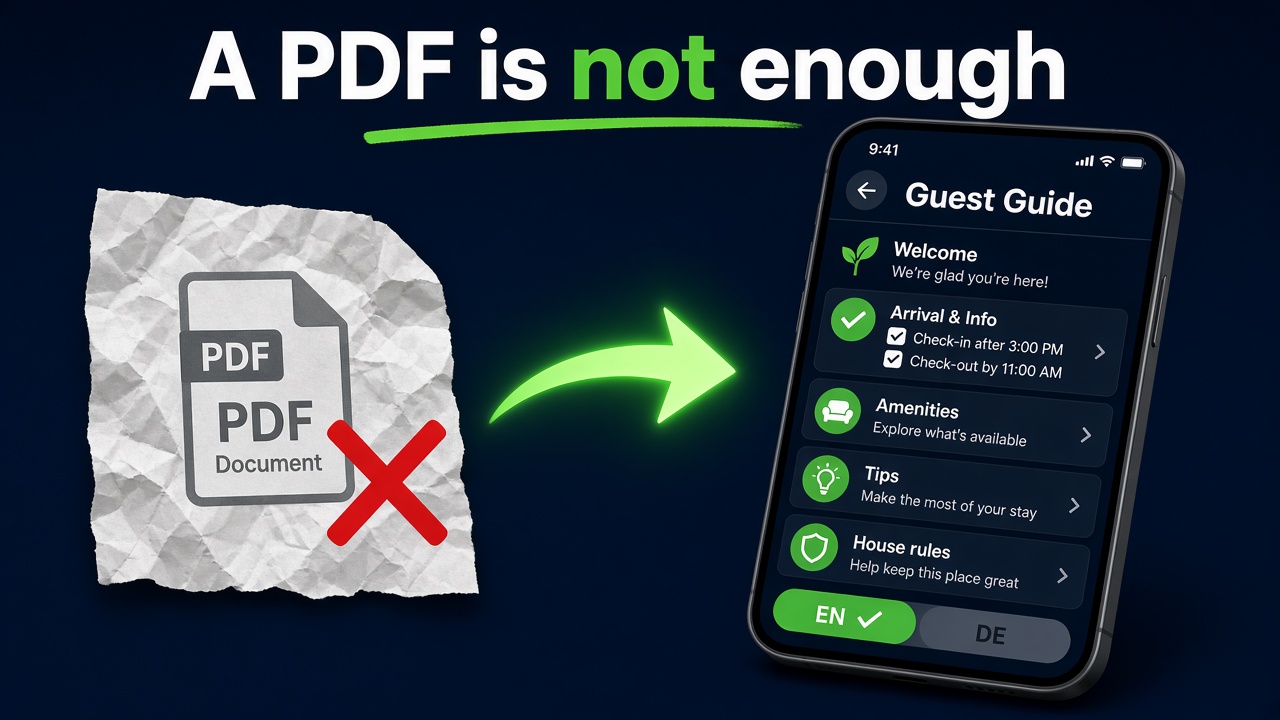
Many vacation-rental hosts in Germany and Austria still send a PDF guest book before arrival: Wi‑Fi, bins, hob, house rules, local tips — everything in one file. On paper it looks professional. In practice most guests never open it on the train platform.
Instead, at 10pm: “How do I get in?” or “What’s the Wi‑Fi?” Exactly the problem the guide was meant to solve.
What hosts actually need
Guests need two things at two different moments — not a 12-page reader:
- At the door: address, directions, code / keys, parking. Short. In the Airbnb message that sits at the bottom of the chat.
- Inside: Wi‑Fi, appliances, waste, checkout, tips. On the phone, updatable, no PDF pinch-zoom.
Stuff both into the same PDF days early and the critical info drowns in noise.
The failure is rarely “too little information.” It’s usually the wrong moment and the wrong format.
PDF vs interactive digital guest guide
A digital guest guide (digital house manual) is a mobile-friendly page instead of a file. Advantages over PDF:
- Update instantly — no re-export, no re-send
- Bilingual DE/EN in one structure — normal for international guests across DACH and NL
- Sections instead of endless scroll
- Link or QR instead of an attachment messengers crush
PDF is still fine as an offline backup. As the primary channel for check-in and Wi‑Fi in 2026, it’s often the weakest option.
Check-in as the start of the relationship — not a PDF attachment
More hosts deliberately split:
- Short pre-arrival message (access only)
- After check-in / once the guest is “in”: link to the guide
Some systems connect both: a light online check-in (name, contact) unlocks the interactive stay guide — more boarding-pass than hotel PMS. That is not a full co-hosting agency. It’s the ops layer for communication and orientation.
In Germany, be sober about data: what you store, why, and how long. No scare tactics — clear notices in privacy policy and the check-in flow. (Not legal advice — check local registration / Zweckentfremdung rules.)
How to measure whether your guide works
Two weeks are enough for an honest test:
- Count messages about Wi‑Fi, hob, bins, checkout
- Change timing (code morning of arrival; guide link after arrival)
- If the count doesn’t drop, the format is still wrong — usually too long or too early
What DropSphere is — and isn’t
DropSphere is our digital guest guide with check-in for short-term rentals: interactive, bilingual, from EUR 9.99/month, 7-day trial. It is not a full co-host and not an “AI replaces the host” promise. For hosts who self-manage and want less chat chaos.
If you want the full ops layer (pricing, channels, handovers), that’s Hosting-as-a-Service. Both are Dropby — different doors.
Try an interactive guide instead of a PDF
7 days free — check-in unlocks the stay guide. Built for DACH hosts.
Open DropSphereNext read: Knowing your guest — why contact details and orientation belong together.